Erfoud fossil town
The ForgivenErfoud fossil town is presented as a place where fossil work is both a familiar livelihood and a source of frustration. Its prepping yards and quarry connect local labor to tourists and foreign customers, while the thin returns from selling fossils expose the economic limits facing the people who depend on them.
Fossil work and the town
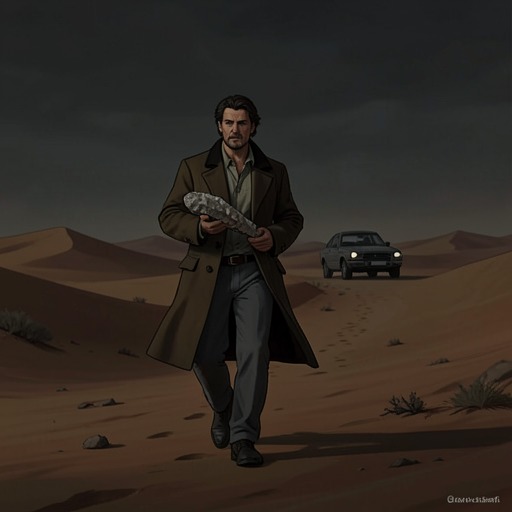
After returning from France, Driss lodges in Erfoud and takes work at Mirzan quarry for the same wage he had earned a year earlier. Ismael sometimes sees him preparing fossils near the telecommunications tower in the town center. With sacking over his head against the sun, Driss chips meticulously at Tridents obtained on the black market. He has worked as a prepper all his life, as Ismael has, but familiarity has not made the occupation satisfying: Driss hates it precisely because it is what he knows.
Driss also appears at the Green Coconut and Hotel Tafilalet, talking loudly at the ammonite bar and boasting of the money he makes from tourists at the five-star ksour hotels on the outskirts. The contrast between those claims and his return to the same quarry wage gives the town’s fossil economy two faces: the possibility of tourist money and the persistence of work that offers little change in circumstance.
Quarry labor and fossil commerce
On days off from the quarry, Driss still comes there early, waiting by the entrance with a teapot and harmonica. Little girls bring him pieces of bread from the foreman. In the afternoon heat, he and Ismael work on a great ancient fish commissioned by a customer from Spain for a private bar; they continue after dark, making fires above the cliff. Ammonites and Crinoids remain partly exposed in its walls, fossils embedded in a landscape where extraction is also ordinary, strenuous labor.
Hamid’s account of the Aït Kebbash places Erfoud within a wider trade sustained by people with few resources. He sees fossil diggers and preppers eking out a subsistence by selling second-rate trilobites in tourist shops in Erfoud and Rissani, or approaching hotel tables with trays of goods in the hope of finding Western buyers. Many, he observes, return to their shacks on the edge of the desert empty-handed. The fossil trade is not a reliable route out of poverty but a narrow, uncertain means of getting by.
Economic and narrative significance
The town’s fossil business sits against the decline of the oases: Hamid notes the spread of Bayoud disease among the trees and the popular view that little remains to local people beyond a trickle of trade in fossilized fish. Against that background, Driss’s boasting about tourist earnings, his unchanged quarry wage, and his continued preparation work register competing versions of the same livelihood: aspiration, repetition, and need.
Erfoud fossil town also anchors Ismael’s understanding of Driss. He sees the returned emigrant not as a success abroad but as thinner, more irritable, and less charming than before, still caught in work they began together as boys. The town’s yards and fossil market make that return concrete: Driss has come back to a trade he resents because it is the work available to him.